

Specifications
Surface Treatments
Certifications
- ISO 9001 - 2015 Certified
- PED 2014/68/EC
- NACE MR0175/ISO 15156-2
- NORSOK M-650
- DFAR
- MERKBLATT AD 2000 W2/W7/W10

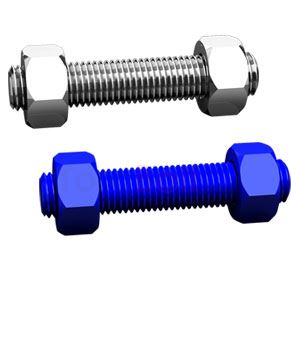
21CrMoV5-7 tap studs are double-end studs with a blind-tap end on one side (anchored into a tapped hole in the parent casing) and a nut-end on the other side. The dominant fastener for steam-turbine half-joint bolting and gas-turbine casing flange bolting, supplied from EN 10269 1.7709 bar in M16 to M120 thread sizes.
The tap-end thread length is conventionally 1.0 to 1.25 times the major diameter. The nut-end thread length is the overall stud length minus the tap-end length minus the central plain shank. Three configurations: standard tap stud (DIN 938 / DIN 939); extended tap stud for thick casing walls; reduced-shank tap stud for cyclic-fatigue service.
| Standard | Thread range | Length range |
|---|---|---|
| DIN 938 (tap-end 1.0 x d) | M16 to M120 | 50 to 800 mm |
| DIN 939 (tap-end 1.25 x d) | M16 to M120 | 50 to 800 mm |
| DIN 940 / DIN 949 (tap-end 2.0 x d / 2.5 x d) | M16 to M120 | 50 to 800 mm |
| Unified inch tap studs (ASME) | 5/8 inch to 4 inch | 2 inch to 32 inch |
| Property | Value | Condition |
|---|---|---|
| Tensile (Rm) | 700 to 850 MPa | RT, Q+T |
| 0.2 percent proof stress (Rp0.2) | ≥550 MPa | RT, Q+T |
| Elongation A5 | ≥16 percent | RT, longitudinal |
| Charpy V impact (KV) | ≥63 J | 20 deg C |
| 0.2 percent proof at 500 deg C | ≥450 MPa | elevated-temp |
| Hardness | 210 to 250 HBW | Q+T |
Manufactured to EN 10269 chemistry and mechanicals. Dimensional standards: DIN 938 / DIN 939 / DIN 940 / DIN 949 for tap-end length ratio. Thread to ISO 261 (metric coarse) or ASME B1.1 (Unified). Inspection to EN 10204 type 3.1 with type 3.2 witness on call-out, standard practice for turbine OEM procurement (Siemens, GE, BHEL, Mitsubishi Power).
Matched-grade Cr-Mo-V companions ship from the same heat lot on call-out: 21CrMoV5-7 nuts, washers, threaded rod, stud bolts and round bar.
Tap studs are specified primarily in steam turbine HP and IP casing bolting at metal temperatures to 550 deg C, and in gas turbine compressor casing flanges. Companion body-bound studs are used in the same joints when shear-load transfer through the bolt body is required.
Default delivery is EN 10204 type 3.1 mill test certificate with heat number, melt-shop pour record, chemistry to EN 10269 21CrMoV5-7, room-temperature tensile and 0.2 percent proof stress, elevated-temperature 0.2 percent proof at the design temperature, Charpy V impact at 20 deg C, hardness, full Q+T cycle chart and dimensional report tied to the heat lot. Type 3.2 with Lloyd's Register, DNV, BV, SGS or TUV witness inspection on call-out and standard practice on turbine and pressure-vessel procurement.
21CrMoV5-7 (Werkstoff 1.7709) chemistry is fixed within a tight Cr-Mo-V Q+T window to EN 10269. Carbon at 0.17 to 0.25 percent gives the Q+T hardenability backbone without over-hardening for the secondary temper. Chromium at 1.20 to 1.50 percent provides through-thickness hardenability and stabilises the carbide network for creep. Molybdenum at 0.55 to 0.80 percent suppresses temper embrittlement and contributes to the secondary hardening peak. Vanadium at 0.20 to 0.35 percent drives the V4C3 precipitation during the 680 to 740 deg C temper that locks in the creep envelope. The chemistry window is shared with the AFNOR 20CDV5.7 (French) and Polish 21HMF designations.
| Element | Min % | Max % | Role |
|---|---|---|---|
| Carbon (C) | 0.17 | 0.25 | Q+T hardenability |
| Silicon (Si) | — | 0.40 | Deoxidation |
| Manganese (Mn) | 0.40 | 0.80 | Hardenability + solid-solution |
| Phosphorus (P) | — | 0.030 | Tramp limit for toughness |
| Sulphur (S) | — | 0.030 | Tramp limit |
| Chromium (Cr) | 1.20 | 1.50 | Hardenability + creep |
| Molybdenum (Mo) | 0.55 | 0.80 | Secondary hardening |
| Vanadium (V) | 0.20 | 0.35 | V4C3 carbide strengthening |
| Nickel (Ni) | — | 0.60 | Residual |
| Aluminium (Al) | — | 0.030 | Grain refinement |
The defining value-prop of 21CrMoV5-7 is the secondary-hardening creep envelope driven by V4C3 carbide precipitation. The fine V4C3 dispersion formed during the 680 to 740 deg C temper pins dislocation motion during long-time elevated-temperature service. The result is a 100,000-hour stress-rupture envelope to EN 10269 Annex A of approximately 340 MPa at 500 deg C, 290 MPa at 525 deg C, 260 MPa at 540 deg C, and 180 MPa at 550 deg C. Above 550 deg C the V4C3 coarsens faster than the design can tolerate; this is the boundary where the design must step up to Durehete 1055 (Alloy T41 / 1.7729) with Ti+B microalloying for grain-boundary pinning that extends the envelope to 568 deg C continuous service.
| Temperature | 100,000 h rupture stress | 1 percent creep strain at 100,000 h |
|---|---|---|
| 450 deg C | ~470 MPa | ~380 MPa |
| 500 deg C | ~340 MPa | ~280 MPa |
| 525 deg C | ~290 MPa | ~235 MPa |
| 540 deg C | ~260 MPa | ~210 MPa |
| 550 deg C | ~180 MPa | ~150 MPa |
The standard cycle for 21CrMoV5-7 is austenitisation at 880 to 940 deg C with hold time of 1 hour per 25 mm section, followed by oil quench. The temper is at 680 to 740 deg C for minimum 2 hours then air cool. The temper temperature is chosen to land on the secondary-hardening peak; below 660 deg C the V4C3 carbide precipitation is under-developed and long-term creep performance suffers; above 750 deg C the carbides over-coarsen and the room-temperature yield drops below the EN 10269 floor of 550 MPa. For heavily machined fastener blanks where dimensional stability matters, a stress relief at 50 deg C below the final temper is recommended after machining.
21CrMoV5-7 is welded with matched-composition Cr-Mo-V low-hydrogen filler (AWS A5.5 E9018-B3L for SMAW, AWS A5.28 ER90S-B3L for GTAW, AWS A5.23 EB3 for SAW) under preheat 200 to 300 deg C and diffusible-hydrogen cap of 5 ml per 100 g deposited. Post-weld heat treatment at 690 to 720 deg C for 1 hour per 25 mm joint thickness, minimum 2 hours, slow furnace cool to 300 deg C then air cool. The PWHT re-tempers the heat-affected zone and restores creep performance. Hardness traverse across weld plus HAZ plus parent metal verifies the PWHT achieved the intended tempering; HAZ hardness must not exceed 320 HBW.
21CrMoV5-7 sits between ASTM A193 Grade B7 (carbon-Mo only, no vanadium, capped at 450 deg C) and Durehete 1055 (Alloy T41 with Ti+B microalloying, 568 deg C envelope). Its direct US cousin is ASTM A193 Grade B16, with overlapping Cr-Mo-V chemistry and similar 540 deg C service envelope. Dual-certification to EN 10269 21CrMoV5-7 plus ASTM A193 B16 from the same heat lot is standard practice on cross-procurement projects.
| Grade | Chemistry | Max temp | When to specify |
|---|---|---|---|
| ASTM A193 B7 | Cr-Mo (no V) | 450 deg C | Lower-temp bolting where cost matters |
| 21CrMoV5-7 | Cr-Mo-V Q+T | 550 deg C | Workhorse mid-tier turbine + power + refinery |
| ASTM A193 B16 | Cr-Mo-V Q+T | 540 deg C | US dual-cert cousin |
| 21CrMoV5-11 (1.8070) | Cr-Mo-V Q+T higher Mo | 550 deg C | Heavier section (OD above 200 mm) |
| Durehete 1055 (Alloy T41 / 1.7729) | Cr-Mo-V-Ti-B | 568 deg C | HP turbine + supercritical + USC |
Q. What is the difference between DIN 938 and DIN 939 tap studs?
The tap-end thread length differs: DIN 938 is 1.0 x diameter; DIN 939 is 1.25 x diameter. DIN 939 gives slightly more thread engagement in the parent casing for heavier-loaded turbine joints. DIN 940 (2.0 x d) and DIN 949 (2.5 x d) are used for deeper engagement in cast-iron or aluminium parent material.
Q. Why use a tap stud instead of a through-bolt on a turbine casing?
On a turbine half-joint where the casing thickness can run 300 to 600 mm, a through-bolt would have to span the full casing thickness and the shank would be uneconomical. A tap stud anchors into a blind tapped hole one one side and accepts a nut on the other, halving the effective bolt length.
Q. What is the maximum thread size for 21CrMoV5-7 tap studs?
M120 in metric, 4 inch in Unified. Larger sizes on call-out from forged blank with custom thread cutting.
Q. Do you supply tap studs with EN 10204 type 3.2 certification?
Yes. Type 3.2 with Lloyd's, DNV, BV, SGS or TUV witness inspection is the standard practice on every Siemens, GE, BHEL, Mitsubishi Power turbine procurement.
Browse the full 21CrMoV5-7 form-factor range: Round Bar · Stud Bolts · Hex Bolts · Heavy Hex Bolts · Body-Bound Studs · Anchor Bolts · U-Bolts · Threaded Rod · Nuts · Washers · Forgings. Back to the 21CrMoV5-7 Alloy Hub.