

Specifications
Surface Treatments
Certifications
- ISO 9001 - 2015 Certified
- PED 2014/68/EC
- NACE MR0175/ISO 15156-2
- NORSOK M-650
- DFAR
- MERKBLATT AD 2000 W2/W7/W10
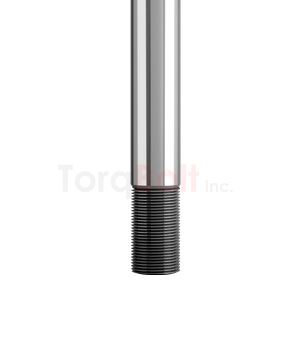
21CrMoV5-7 (Werkstoff 1.7709, AFNOR 20CDV5.7, Polish PN 21HMF) is a chromium-molybdenum-vanadium creep-resistant bolting steel specified in EN 10269 for elevated-temperature fastener service to 550 deg C continuous. The grade is the European workhorse for steam turbine casing bolts, gas turbine compressor flanges, power plant pressure-vessel bolting, and refinery fired-heater flange studs in the temperature window that sits below the 21CrMoV5-7 (Alloy T41) envelope and above the carbon-molybdenum ASTM A193 B7 envelope.
21CrMoV5-7 is a quenched-and-tempered Cr-Mo-V low-alloy steel with carbide-precipitation strengthening from secondary vanadium carbides formed during tempering. The chromium provides solid-solution hardenability through-thickness. The molybdenum suppresses temper embrittlement and contributes to creep resistance. The vanadium drives the secondary hardening peak in the 680 to 740 deg C temper range, locking in the creep-rupture performance that defines the grade. The resulting microstructure is a tempered bainite with fine V4C3 precipitates and a residual ferrite fraction that together deliver yield strength above 550 MPa with Charpy V impact above 63 J at room temperature, holding 0.2 percent proof stress above 450 MPa at 500 deg C.
21CrMoV5-7 has a stable cross-reference chain across the major industrial standards. The European Norm designation 21CrMoV5-7 is the canonical name. The Werkstoff number 1.7709 identifies the grade in the German steel-numbers register. The AFNOR designation 20CDV5.7 is the French naming used in EDF, Areva, and Framatome procurement specifications. The Polish PN designation 21HMF is the equivalent for boiler and turbine bolting in Eastern European power plants. The closest US bolting standard is ASTM A193 Grade B16, a Cr-Mo-V chemistry with similar temper range and service envelope; B16 is not an exact substitute but covers comparable design conditions.
| Designation system | Grade name | Standard |
|---|---|---|
| European Norm (EN) | 21CrMoV5-7 | EN 10269 |
| Werkstoff (DIN) | 1.7709 | EN 10269 |
| AFNOR (France) | 20CDV5.7 | NF A35-559 |
| Polish PN | 21HMF | PN-89/H-84030 |
| ASTM (US, closest) | A193 Grade B16 | ASTM A193 |
| Sister grade (heavier section) | 21CrMoV5-11 / 1.8070 | EN 10269 |
| Element | Min % | Max % | Notes |
|---|---|---|---|
| Carbon (C) | 0.17 | 0.25 | Q+T hardenability backbone |
| Silicon (Si) | — | 0.40 | Deoxidation residual |
| Manganese (Mn) | 0.40 | 0.80 | Solid-solution strengthening |
| Phosphorus (P) | — | 0.030 | Tramp limit for impact toughness |
| Sulphur (S) | — | 0.030 | Tramp limit for transverse toughness |
| Chromium (Cr) | 1.20 | 1.50 | Hardenability and creep |
| Molybdenum (Mo) | 0.55 | 0.80 | Secondary hardening and creep |
| Vanadium (V) | 0.20 | 0.35 | V4C3 precipitation, secondary hardening peak |
| Nickel (Ni) | — | 0.60 | Residual |
| Aluminium (Al) | — | 0.030 | Grain refinement; deoxidation |
| Property | Value | Test condition |
|---|---|---|
| Tensile strength (Rm) | 700 to 850 MPa | RT, Q+T condition |
| 0.2 percent proof stress (Rp0.2) | >=550 MPa (typical 650) | RT, Q+T condition |
| Elongation A5 | >=16 percent | RT, longitudinal |
| Charpy V impact (KV) | >=63 J | 20 deg C, longitudinal |
| 0.2 percent proof at 500 deg C | >=450 MPa | EN 10269 elevated-temp |
| 0.2 percent proof at 550 deg C | >=420 MPa | EN 10269 elevated-temp |
| Tensile at 550 deg C | ~600 MPa | Producer datasheets |
| Hardness (HBW) | 210 to 250 | RT, Q+T condition |
The standard cycle is austenitise 880 to 940 deg C, hold long enough to fully transform to austenite (typically one hour per 25 mm of section thickness), then oil quench. The temper is 680 to 740 deg C, hold at least 2 hours, then air cool. The temper temperature is chosen to land on the secondary hardening peak; tempering too low (below 660 deg C) leaves the V4C3 underdeveloped and the long-time creep performance suffers; tempering too high (above 750 deg C) over-coarsens the carbides and drops the room-temperature yield below the EN 10269 floor. For heavily machined fastener blanks, a stress-relief 50 deg C below the final temper is recommended to control distortion. Inter-pass tempering and PWHT for welded joints are specified separately on the welding page.
21CrMoV5-7 is welded with matched-composition Cr-Mo-V low-hydrogen filler under preheat 200 to 300 deg C with strict diffusible-hydrogen control (typical limit 5 ml/100 g deposited). Post-weld heat treatment at 690 to 720 deg C is required to temper the heat-affected zone and restore creep performance; PWHT hold time is typically 1 hour per 25 mm joint thickness with a minimum of 2 hours. Visual inspection to ISO 5817 quality level B is standard; magnetic-particle and dye-penetrant on cap and root; ultrasonic on butt joints above 25 mm. Hardness traverse across weld plus HAZ plus parent verifies the PWHT achieved the intended tempering; hardness should not exceed 320 HBW at any point.
| Standard | Scope | Relevance to 21CrMoV5-7 |
|---|---|---|
| EN 10269 | Steels and nickel alloys for fasteners, elevated/low-temp | Controlling spec — chemistry, mechanicals, inspection |
| EN 10269:2013 + A1:2024 | Latest amended revision | Current edition in force |
| EN 10278 | Cold-drawn bright steel bars | For drawn bar dimensional tolerance |
| DIN EN 10269 | German national variant of EN 10269 | Same technical content; DIN imprint for DACH procurement |
| BS EN 10269 | British national variant | Same technical content; BS imprint for UK procurement |
| VdTUV Wb 350 | German pressure-vessel approval scope | Parallel approval for unfired pressure vessels |
| ASTM A193 Grade B16 | US Cr-Mo-V bolting standard | Closest US equivalent; not exact substitute |
| EN 10204 type 3.1 / 3.2 | Inspection document categories | Standard 3.1 with 3.2 third-party witness on call-out |
| Grade | Werkstoff | Service envelope | Why choose / when to step |
|---|---|---|---|
| Durehete 1055 (Alloy T41) | 1.7729 | up to 568 deg C | Step UP when service exceeds 550 deg C continuous (Ti+B microalloying) |
| Durehete 950 (Alloy T31) | 1.7711 | up to 540 deg C | Overlapping mid-tier; choose for ASTM A193 B16 specifications |
| 21CrMoV5-7 | 1.7709 | up to 550 deg C | Workhorse mid-tier — turbine, power, refinery |
| 21CrMoV5-11 | 1.8070 | up to 550 deg C | Heavier-section variant with extended hardenability for thick forgings |
| 24CrMoV5-5 | 1.7733 | up to 500 deg C | Adjacent EN 10269 grade for lower-temp service |
| ASTM A193 Grade B7 | — | up to 450 deg C | Carbon-Mo only, no V; step DOWN for non-creep service |
21CrMoV5-7 is specified into bolting where the design metal temperature exceeds the ASTM A193 B7 envelope but does not require the premium creep performance of 21CrMoV5-7. The 8 primary service areas are linked from the Applications dropdown above and from the body block below.
TorqBolt supplies 21CrMoV5-7 in the full bolting form-factor range, from raw bar through finished fasteners, all to EN 10269 (cold-drawn additionally to EN 10278) with EN 10204 type 3.1 mill test certificate by default and type 3.2 with third-party witness on call-out.
| Form factor | Standard sizes | Page |
|---|---|---|
| Round bar (raw) | OD 16 to 300 mm | Round Bar |
| Stud bolts (flange bolting) | M12 to M120, lengths 50 to 800 mm | Stud Bolts |
| Hex bolts (DIN 931 / ISO 4014) | M12 to M64 | Hex Bolts |
| Heavy hex bolts (ASME B18.2.1) | 1/2" to 4" | Heavy Hex Bolts |
| Tap studs (turbine half-joint) | M16 to M120, lengths 50 to 800 mm | Tap Studs |
| Body-bound studs (reamer bolts) | M16 to M120 H7/n6 fit | Body-Bound Studs |
| Anchor bolts | M16 to M64 | Anchor Bolts |
| U-bolts (pipe support) | per project drawing | U-Bolts |
| Threaded rod | M12 to M64, cut to length | Threaded Rod |
| Nuts (matched-grade) | M12 to M120 | Nuts |
| Washers (matched-grade) | M12 to M64 | Washers |
| Forgings (large blank) | up to 800 kg piece | Forgings |
Q. Is 21CrMoV5-7 the same as 1.7783?
No. 1.7783 is X22CrMoV12-1, a 12 percent chromium martensitic stainless steel for steam-turbine blades — an entirely different alloy class. 21CrMoV5-7 is Werkstoff 1.7709, a low-alloy Cr-Mo-V bolting steel.
Q. Is 21CrMoV5-7 an exact substitute for ASTM A193 Grade B16?
Not exact, but close. Both are Cr-Mo-V Q+T bolting steels with overlapping service envelopes. B16 chemistry sits within the 21CrMoV5-7 window for Cr, Mo and V. Procurement specifications that allow either grade typically include both designations on the same order line.
Q. What is the maximum service temperature for 21CrMoV5-7?
550 deg C continuous, to EN 10269. Above 550 deg C the design must step up to Durehete 1055 (Alloy T41 / 1.7729) for the Ti+B-microalloyed creep performance.
Q. Do you supply 21CrMoV5-7 with EN 10204 type 3.2 certification?
Yes. Type 3.1 is supplied by default with heat number, chemistry, Q+T cycle, mechanical results, hardness and dimensional report. Type 3.2 with Lloyd's Register, DNV, BV, SGS or TUV witness is supplied on call-out and is standard practice on turbine and pressure-vessel procurement.
Q. What is the difference between 21CrMoV5-7 and 21CrMoV5-11?
The 5-11 variant (1.8070) has extended hardenability for heavier section thicknesses through a slightly higher Mn and tighter Mo range. For round bar above OD 200 mm in fully-hardened condition, 21CrMoV5-11 is the preferred grade. For OD 16 to 200 mm, 21CrMoV5-7 is the workhorse.