

Specifications
Surface Treatments
Certifications
- ISO 9001 - 2015 Certified
- PED 2014/68/EC
- NACE MR0175/ISO 15156-2
- NORSOK M-650
- DFAR
- MERKBLATT AD 2000 W2/W7/W10

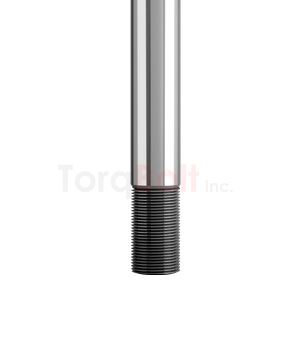
21CrMoV5-7 steam turbine bolts hold the casing halves, valve bodies and steam-line flanges of LP, IP and lower-HP turbine stages. To EN 10269, the grade carries continuous service to 550 deg C metal temperature with Cr-Mo-V Q+T creep performance. Above 550 deg C the design steps up to Durehete 1055 (Alloy T41 / 1.7729) for the Ti+B microalloyed creep envelope. TorqBolt supplies the full bolting set: studs, nuts, washers, threaded rod and tap studs from the same heat lot.
| Stage | Typical metal temp | 21CrMoV5-7 use | If above envelope |
|---|---|---|---|
| LP (low-pressure) | 200 to 380 deg C | Primary choice; cost-effective vs Durehete | n/a |
| IP (intermediate-pressure) | 400 to 530 deg C | Primary choice; full creep envelope | n/a |
| HP (high-pressure, lower stages) | 500 to 550 deg C | Primary choice; design margin tight | Step to Durehete 1055 above 550 |
| HP (high-pressure, upper stages) | 550 to 568 deg C | Outside envelope | Durehete 1055 (Alloy T41 / 1.7729) |
| Supercritical HP main | 568 to 600 deg C | Outside envelope | Durehete 1055 with USC creep margin |
| Property | RT | 500 deg C | 550 deg C |
|---|---|---|---|
| 0.2 percent proof stress (Rp0.2) | >=550 MPa | >=450 MPa | >=420 MPa |
| Tensile (Rm) | 700 to 850 MPa | >=600 MPa | ~600 MPa |
| Elongation A5 | >=16 percent | maintained | maintained |
| Stress-rupture (100,000 h) | n/a | >=260 MPa | >=180 MPa |
21CrMoV5-7 steam-turbine bolting is specified to EN 10269 for chemistry, mechanicals and inspection categories. Pressure-vessel parallel approval to VdTUV Wb 350 for combined turbine-pressure-vessel assemblies. Cross-procurement on US-design turbines uses ASTM A193 Grade B16 with dual-certification on call-out.
For HP main steam casings above 550 deg C, supercritical main bolting, and ultra-supercritical projects, the design steps up to Durehete 1055 (Alloy T41 / Werkstoff 1.7729 / 20CrMoVTiB4-10) with Ti+B microalloying for the extended creep envelope. For heavier sections of the same temperature window, the sister grade 21CrMoV5-11 (1.8070) provides extended hardenability without changing the alloy class.
21CrMoV5-7 (Werkstoff 1.7709) chemistry is fixed within a tight Cr-Mo-V Q+T window to EN 10269. Carbon at 0.17 to 0.25 percent gives the Q+T hardenability backbone without over-hardening for the secondary temper. Chromium at 1.20 to 1.50 percent provides through-thickness hardenability and stabilises the carbide network for creep. Molybdenum at 0.55 to 0.80 percent suppresses temper embrittlement and contributes to the secondary hardening peak. Vanadium at 0.20 to 0.35 percent drives the V4C3 precipitation during the 680 to 740 deg C temper that locks in the creep envelope. The chemistry window is shared with the AFNOR 20CDV5.7 (French) and Polish 21HMF designations.
| Element | Min % | Max % | Role |
|---|---|---|---|
| Carbon (C) | 0.17 | 0.25 | Q+T hardenability |
| Silicon (Si) | — | 0.40 | Deoxidation |
| Manganese (Mn) | 0.40 | 0.80 | Hardenability + solid-solution |
| Phosphorus (P) | — | 0.030 | Tramp limit for toughness |
| Sulphur (S) | — | 0.030 | Tramp limit |
| Chromium (Cr) | 1.20 | 1.50 | Hardenability + creep |
| Molybdenum (Mo) | 0.55 | 0.80 | Secondary hardening |
| Vanadium (V) | 0.20 | 0.35 | V4C3 carbide strengthening |
| Nickel (Ni) | — | 0.60 | Residual |
| Aluminium (Al) | — | 0.030 | Grain refinement |
The defining value-prop of 21CrMoV5-7 is the secondary-hardening creep envelope driven by V4C3 carbide precipitation. The fine V4C3 dispersion formed during the 680 to 740 deg C temper pins dislocation motion during long-time elevated-temperature service. The result is a 100,000-hour stress-rupture envelope to EN 10269 Annex A of approximately 340 MPa at 500 deg C, 290 MPa at 525 deg C, 260 MPa at 540 deg C, and 180 MPa at 550 deg C. Above 550 deg C the V4C3 coarsens faster than the design can tolerate; this is the boundary where the design must step up to Durehete 1055 (Alloy T41 / 1.7729) with Ti+B microalloying for grain-boundary pinning that extends the envelope to 568 deg C continuous service.
| Temperature | 100,000 h rupture stress | 1 percent creep strain at 100,000 h |
|---|---|---|
| 450 deg C | ~470 MPa | ~380 MPa |
| 500 deg C | ~340 MPa | ~280 MPa |
| 525 deg C | ~290 MPa | ~235 MPa |
| 540 deg C | ~260 MPa | ~210 MPa |
| 550 deg C | ~180 MPa | ~150 MPa |
The standard cycle for 21CrMoV5-7 is austenitisation at 880 to 940 deg C with hold time of 1 hour per 25 mm section, followed by oil quench. The temper is at 680 to 740 deg C for minimum 2 hours then air cool. The temper temperature is chosen to land on the secondary-hardening peak; below 660 deg C the V4C3 carbide precipitation is under-developed and long-term creep performance suffers; above 750 deg C the carbides over-coarsen and the room-temperature yield drops below the EN 10269 floor of 550 MPa. For heavily machined fastener blanks where dimensional stability matters, a stress relief at 50 deg C below the final temper is recommended after machining.
21CrMoV5-7 is welded with matched-composition Cr-Mo-V low-hydrogen filler (AWS A5.5 E9018-B3L for SMAW, AWS A5.28 ER90S-B3L for GTAW, AWS A5.23 EB3 for SAW) under preheat 200 to 300 deg C and diffusible-hydrogen cap of 5 ml per 100 g deposited. Post-weld heat treatment at 690 to 720 deg C for 1 hour per 25 mm joint thickness, minimum 2 hours, slow furnace cool to 300 deg C then air cool. The PWHT re-tempers the heat-affected zone and restores creep performance. Hardness traverse across weld plus HAZ plus parent metal verifies the PWHT achieved the intended tempering; HAZ hardness must not exceed 320 HBW.
21CrMoV5-7 sits between ASTM A193 Grade B7 (carbon-Mo only, no vanadium, capped at 450 deg C) and Durehete 1055 (Alloy T41 with Ti+B microalloying, 568 deg C envelope). Its direct US cousin is ASTM A193 Grade B16, with overlapping Cr-Mo-V chemistry and similar 540 deg C service envelope. Dual-certification to EN 10269 21CrMoV5-7 plus ASTM A193 B16 from the same heat lot is standard practice on cross-procurement projects.
| Grade | Chemistry | Max temp | When to specify |
|---|---|---|---|
| ASTM A193 B7 | Cr-Mo (no V) | 450 deg C | Lower-temp bolting where cost matters |
| 21CrMoV5-7 | Cr-Mo-V Q+T | 550 deg C | Workhorse mid-tier turbine + power + refinery |
| ASTM A193 B16 | Cr-Mo-V Q+T | 540 deg C | US dual-cert cousin |
| 21CrMoV5-11 (1.8070) | Cr-Mo-V Q+T higher Mo | 550 deg C | Heavier section (OD above 200 mm) |
| Durehete 1055 (Alloy T41 / 1.7729) | Cr-Mo-V-Ti-B | 568 deg C | HP turbine + supercritical + USC |
Q. What is the metal-temperature envelope for 21CrMoV5-7 in steam turbine bolting?
Up to 550 deg C continuous metal temperature to EN 10269. Covers LP, IP and lower-HP casings. Above 550 deg C the design steps up to Durehete 1055.
Q. Which stud form is used for steam turbine half-joint bolting?
Tap studs and body-bound studs. Tap studs anchor into a blind tapped hole; body-bound studs have a ground precision shank to H7/n6 for cyclic-load joints.
Q. Do you supply matched-grade nuts and washers from the same heat lot?
Yes. Companion nuts and washers in 21CrMoV5-7 from the same heat lot as the stud are supplied on call-out and are standard practice on turbine procurement.
Q. What PWHT cycle do you use for welded steam-turbine attachments?
PWHT at 690 to 720 deg C, 1 hour per 25 mm minimum 2 hours, slow furnace cool to 300 deg C, then air cool. Hardness traverse verifies the PWHT achieved the intended tempering.
More 21CrMoV5-7 service applications: Gas Turbine Bolts · Power Plant Bolting · Pressure Vessel Bolts · Boiler Bolts · Heat Exchanger Bolts · Fired Heater Bolts · Petrochem Reactor Bolts. Back to the 21CrMoV5-7 Alloy Hub.